
Jacqueline Gelineau, CBC News
May 5, 2026
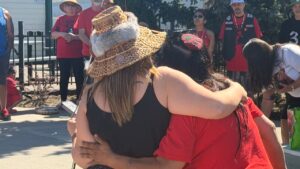
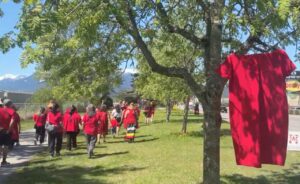
Steadfast and dressed in red, hundreds gathered in Terrace, B.C., for Red Dress Day to recognize Indigenous people who have been missing or murdered, and call for change.
Across Canada on May 5, red dresses are hung, people march and hold vigils to commemorate missing and murdered Indigenous women, girls and 2SLGBTQ+ people.
“It’s a powerful day to recognize those that have gone missing. And here in Terrace, we also recognize those that have gone missing on the Highway of Tears,” said Lorna Brown, executive director and founder of the Tears to Hope Society.
Brown said nearly everyone living in northern B.C., along the 724-kilometre stretch of Highway 16 between Prince Rupert to Prince George, has felt the loss of someone who has gone missing, or been murdered on the Highway of Tears.
Her niece Tamara Chipman, 22, went missing from Prince George in 2005.
“The following spring my cousin did a walk,” said Brown.
That march in 2006, marked the first Highway of Tears awareness walk.
“They just wanted to bring some awareness to what was happening in our communities.”
Brown said back then Red Dress Day was not yet a nationwide movement.
In 2022, the federal and provincial governments brought cellphone coverage to Highway 16 from Prince Rupert to Prince George. This came in response to a Highway of Tears Symposium Report’s recommendations aimed at enhancing safety for Indigenous women and girls.
Some Indigenous leaders in B.C. have reported that since 1970, more than 50 girls and women have been murdered or have gone missing from the highway. The Highway of Tears Recommendation Report says more than 30 women have been confirmed as missing or murdered, but say the exact number is not known, as some cases have not been recorded.
The Missing and Murdered Indigenous Women and Girls National Action Plan suspects thousands of Indigenous deaths and disappearances across Canada have gone unreported or have been misreported.
“There are loved ones that are missing. Loved ones that are murdered and nobody seems to care,” said Gladys Radek, an elder with the Tears of Hope Society who advocates for missing and murdered Indigenous women and girls, boys and men.
“They don’t take our cases seriously. To major society it’s just another dead Indian,” said Radek.
“There’s a lot of flaws in the judicial system.”
Radek has been involved in advocacy work regarding violence against Indigenous people for more than 20 years. She meets with the families of people who have lost a loved one, and are now grieving with few answers.
According to data from Statistics Canada collected between 2009 and 2021, Indigenous women and girls are six times more likely to be murdered than non-Indigenous females.
Radek said it’s a shame that advocacy and awareness efforts have to continue. She said the government and law enforcement need to update their strategies in handling cases of missing and murdered Indigenous people to better protect and serve the communities that are being impacted.
She also asks that people speak up when they see a woman in need.
“Help her. Don’t keep quiet about it. Stop it. Stop the violence against our women once and for all,” said Radek.
Brown said everyone, but especially non-Indigenous people, needs to take a stand.
“The onus should not be on the Indigenous people or the First Nations women, who have carried the majority of the load,” said Brown.
“Have the courage to stand up.”
To view the full article, please visit www.cbc.ca/news/canada/british-columbia/red-dress-day-bc-9.7189193.