Resources
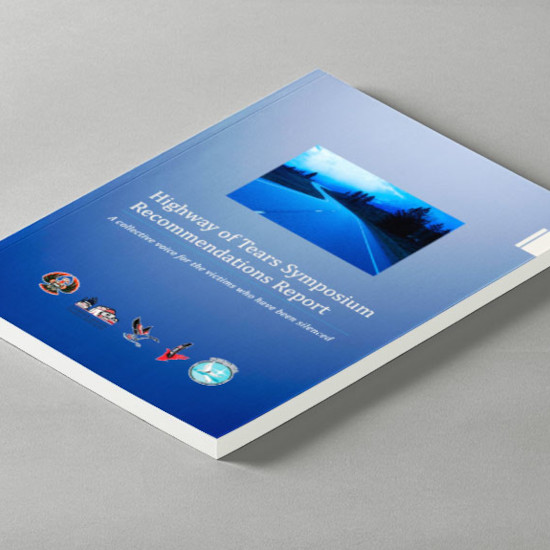
Highway of Tears Symposium Recommendations Report
In 2006, Carrier Sekani Family Services (CSFS), the Lheidhli T’enneh First Nation, Carrier Sekani Tribal Council, Prince George Nechako Indigenous Employment and Training Association, and the Prince George Native Friendship Center created the Highway of Tears Symposium Recommendations Report in memory of all the women and girls who have gone missing or been murdered along the Highway of Tears.
This report captured the personal stories and recommendations shared at the Highway of Tears Symposium in March 2006 by victims’ families and community members. The report contains 33 Recommendations intended to reduce further violence against Indigenous women and girls in four key areas:
1. Victim Prevention
2. Emergency Planning and Team Response
3. Victim Family Counseling and Support
4. Community Development and Support
The purpose of this report is to present all realistic and achievable Highway of Tears Symposium Recommendations. Each Recommendation listed is a specific direction and call for action with supporting rationale.
We continue to work to implement each of the 33 Recommendations and are currently working on a research project to assess which Recommendations have been implemented and which still remain to be done. For more information, visit our Research Projects page.
The Recommendations Report can be viewed here: Highway of Tears Symposium Recommendations Report.
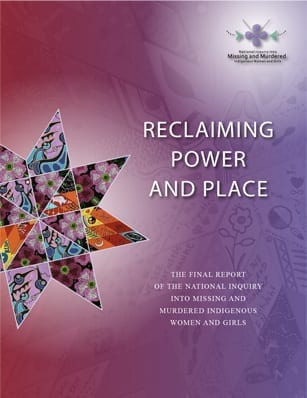
Reclaiming Power and Place: The Final Report of the National Inquiry into MMIWG
In 2016, the federal government of Canada responded to persistent calls from families, loved ones, and community members of Missing and Murdered Indigenous Women and Girls (MMIWG) for action on this issue by launching a National Inquiry into MMIWG. The Inquiry was asked to recommend concrete actions to remove systemic causes of violence and increase the safety of Indigenous women and girls, as well as to recommend ways to commemorate those who have gone missing or been murdered across Canada.
After investigating these issues, the National Inquiry released its Final Report, titled Reclaiming Power and Place, in 2019. This Report puts forward 231 Calls for Justice designed to address the systemic causes of violence against Indigenous women and girls in order to prevent further violence and improve safety. Some of these Calls for Justice are specifically directed at federal and provincial governments, while others are directed at specific sectors that have contributed to the MMIWG crisis or at all Canadians.
The Final Report with the 231 Calls for Justice can be viewed and downloaded here: Final Report | MMIWG.
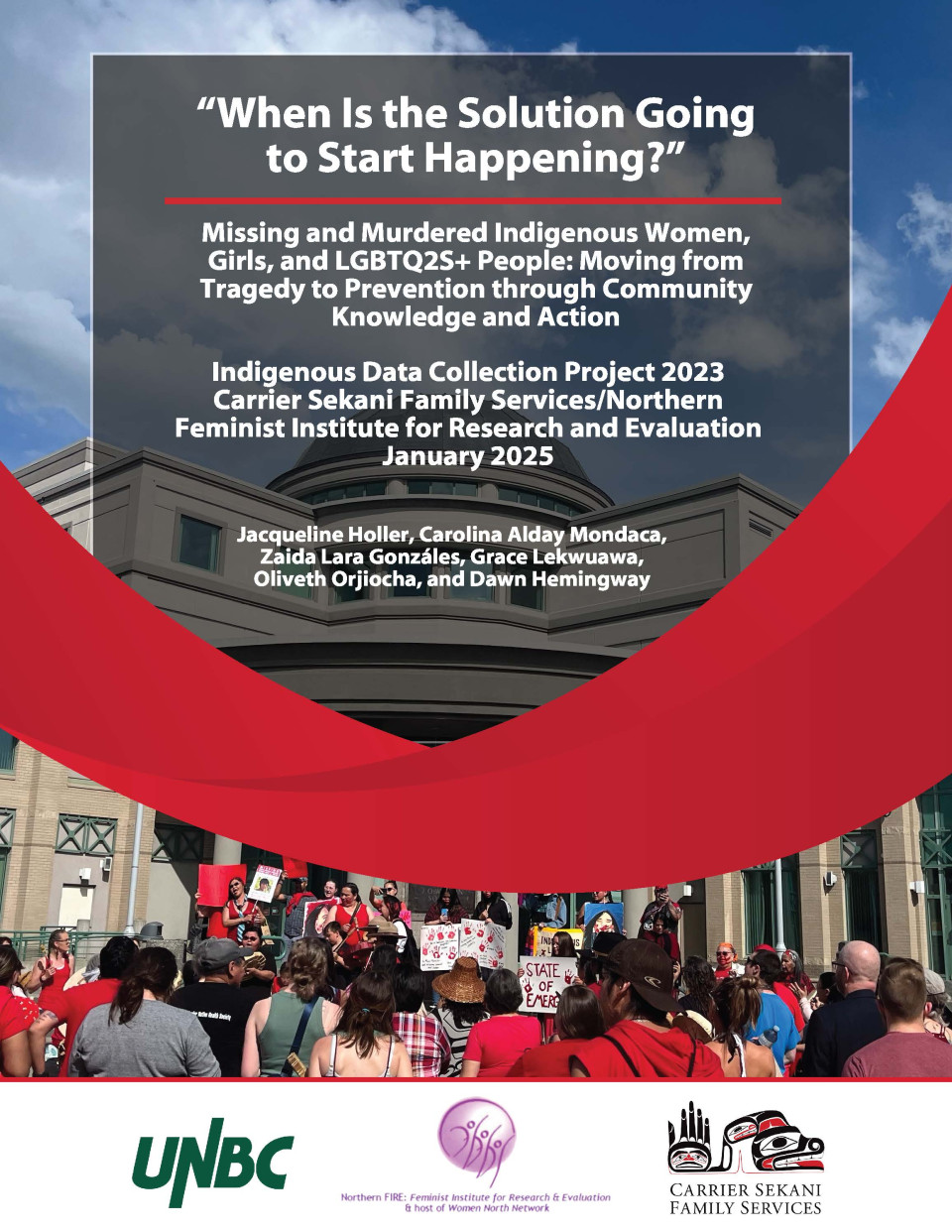
“When is the Solution Going to Start Happening?”
In February 2025, Carrier Sekani Family Services (CSFS) and the Northern Feminist Institute of Research and Evaluation (Northern FIRE) at the University of Northern British Columbia (UNBC) released a research report titled “When is the Solution Going to Start Happening?”
This research, conducted in collaboration with Indigenous leaders, survivors, and community members, sheds light on the systemic barriers that contribute to the overrepresentation of Indigenous women and in gender-based violence statistics and the ongoing crisis of Missing and Murdered Indigenous Women and Girls (MMIWG). The report provides critical recommendations for service providers, government leaders, and policymakers to address the ongoing crisis of gender-based violence against Indigenous women, girls, and 2SLGBTQQIA+ people.
The report can be viewed and downloaded here: “When Is the Solution Going to Start Happening?”
Red Women Rising
In April 2019, the Downtown Eastside Women’s Centre (DEWC) released a report titled Red Women Rising: Indigenous Women Survivors in Vancouver’s Downtown Eastside. This report resulted from a participatory process with 113 Indigenous women and 15 non-Indigenous women regarding the National Inquiry into MMIWG, and it is based on the lived experience, leadership, and expertise of Indigenous survivors.
To view the report, click here: MMIW-Report-Final-March-10-WEB.pdf.
Forsaken: The Report of the Missing Women Commission of Inquiry
Between January 23, 1997 and February 5, 2002, police forces in British Columbia conducted investigations into women reported missing from the Downtown Eastside of the City of Vancouver. Following the investigations, the Honourable Wally T. Oppal, QC, who headed the Missing Women Commission of Inquiry, released a report titled Forsaken: The Report of the Missing Women Commission of Inquiry that summarized the findings.
To view the report, click here: Forsaken: The Report of the Missing Women Commission of Inquiry.
Invisible Women: A Call to Action
In March 2014, the Canadian House of Commons’ Special Committee on Violence against Indigenous Women released a report titled Invisible Women: A Call to Action, which examined the issue of missing and murdered Indigenous women in Canada.
To view the report, click here: Invisible Women: A Call To Action.
Those Who Take Us Away
In February 2014, Human Rights Watch released a report titled Those Who Take Us Away that documented ongoing police failures to protect Indigenous women and girls in northern BC from violence, as well as highlighting an ongoing pattern of violent behavior from police officers against women and girls.
To view the report, click here: Those Who Take Us Away: Abusive Policing and Failures in Protection of Indigenous Women and Girls in Northern British Columbia, Canada.
Native Women’s Association of Canada (NWAC)
The Native Women’s Association of Canada (NWAC) has a number of resources dedicated to Missing and Murdered Indigenous Women and Girls on its website.
To view these resources, click here: MMIWG2S+ Advocacy | NWAC’s Justice for Missing & Murdered Indigenous Women.

Links of Interest
BC Crime Stoppers
BC Crime Stoppers provides people with an opportunity to share information about crimes anonymously. Please visit the BC Crime Stoppers website for more information.
VictimLinkBC
VictimLinkBC is a toll-free, confidential service available across BC and the Yukon 24/7. It provides information and referral services to all victims of crime and immediate crisis support to victims of family and sexual violence, including victims of human trafficking exploited for labour or sexual services. For more information or to access this service, visit the VictimLinkBC website.
Carrier Sekani Family Servies
Carrier Sekani Family Services provides holistic health and social services to Carrier and Sekani peoples in north-central BC. For more information, please visit our website: Carrier Sekani Family Services.
BC Family Information Liaison Unit (BC FILU)
The BC Family Information Liaison Unit (BC FILU) provides specialized services to families of missing and murdered Indigenous people throughout British Columbia. For more information or to contact BC FILU, visit the Family Information Liaison Unit – Province of British Columbia website.
Reporting
If you have any information at all concerning a missing or murdered Indigenous woman or girl, please call the RCMP E-PANA Tip Line at 1-877-543-4822 and visit the Project E-PANA website for more information. No tip is too insignificant to report.
If you need to report someone missing, call 911 immediately.